
Why the Right Words Matter in Maths
Using the correct mathematical vocabulary from the start can help children understand concepts more clearly, explain their thinking and build confidence as maths becomes more complex.
If you've ever sat with your child over their maths homework and found yourself saying "just take away the little number from the big number" instead of "subtract," you're not alone — and you're not doing anything wrong. It's instinct. We want maths to feel accessible, so we soften it.
But here's something I've learned from years of tutoring: children don't need us to simplify the language of maths. They need us to use it properly, from the very start.
Children Can Handle the Real Words
There's a common assumption that mathematical vocabulary — words like numerator, product, equivalent, partition, inverse — is too advanced for primary-aged children, and that it's kinder to substitute everyday language until they're "ready" for the technical terms.
In my experience, this gets things backwards. Children are remarkably capable of absorbing precise vocabulary when it's introduced naturally and used consistently. What actually slows them down isn't the words themselves — it's the confusion that comes later, when the "easy" words they learned at seven don't map cleanly onto the formal vocabulary they're suddenly expected to know at eleven, in secondary school, or in their SATs.
It's an easy, understandable slip to make. A parent might ask "how many corners does it have?" when the correct word is "vertices," or talk about the "sides" of a 3D shape when they mean its "faces." These aren't careless mistakes — they come from a natural instinct to make maths sound friendlier. But if a child learns "corners" at six, they'll eventually have to unlearn that and relearn "vertices."
That's an extra step, an extra bit of friction, at a time when they're already juggling harder concepts. Whereas if they learn "vertices" from the beginning, that word just quietly becomes part of how they think. The same is true for "difference," "sum," "factor," and every other piece of proper mathematical language. Children can have high expectations placed on them from the outset — and, time and again, they rise to meet them.
“Children don’t need mathematical language watered down. They need the right words introduced naturally and used consistently.”
Vocabulary Is the Foundation, Not the Decoration
Correct vocabulary isn't a nice extra layered on top of "real" maths learning — it's part of the thinking itself. When a child can say "I need to find the difference between these two numbers," they're not just using a fancier phrase for "how much bigger." They're building a precise mental model of what subtraction actually represents, one that will still make sense when the numbers get bigger, the problems get wordier, and the stakes get higher in secondary school.
This is why, in my sessions, I talk about maths the way a mathematician would — just at a pace and with a warmth that makes it feel completely natural. If we're working on fractions, I don't say "the top number" and "the bottom number." I say numerator and denominator, every time, without making a big deal of it. Children pick this up astonishingly quickly when it's simply woven into the conversation rather than presented as something to be tested on.
“The top number”
“The bottom number”
Numerator
Denominator
This Isn't Just My Opinion — It's What the Research Shows
I'm not alone in thinking this way. It's a view backed by the organisations that shape how maths is taught in UK primary schools.
Education Endowment Foundation (EEF)
The Education Endowment Foundation's guidance report on improving maths in Key Stages 2 and 3 draws on a review of the best available evidence and consistently points towards the value of precise, mastery-focused teaching — including the explicit, deliberate use of correct mathematical language rather than watered-down alternatives.
EEF — Improving Mathematics in Key Stages 2 and 3
NCETM
The National Centre for Excellence in the Teaching of Mathematics (NCETM) goes further still, arguing that teaching children specific mathematical vocabulary gives them precision and, in their words, opens a door to the world of the mathematician.
Their work on oracy in maths draws on wider research showing that children's early language experiences are powerful predictors of their future achievement, not just in literacy but across the whole curriculum, maths included.
They've also found that when schools raise their expectations around ambitious mathematical vocabulary, it isn't just their highest attainers who benefit — pupils across the ability range engage more confidently and articulately with maths once they're given the real words to think with.
NCETM — Four Ways to Create Better Mathematical Talk
NRICH / University of Cambridge
NRICH, the maths education project run by the University of Cambridge, places a similar emphasis on talk as central to how children develop as mathematicians. Their guidance for teachers describes how, after children have explored a problem hands-on, the next crucial step is introducing the specific vocabulary that names what they've just discovered — cementing the concept in language they can carry forward. NRICH also highlights that tasks designed to be worked through in conversation, in small groups, are what give children the richest opportunities to reason, explain, and build their mathematical language together.
Taken together, this research says the same thing I see every week in my sessions: mathematical vocabulary isn't a hurdle to lower for children — it's a tool that, given to them early and used consistently, helps them think more clearly and achieve more confidently.
NRICH — Developing a Classroom Culture That Supports a Problem-Solving Approach
Why I Keep My Groups Small
This is also exactly why I cap my tutoring groups at four children.
Vocabulary doesn't stick from a worksheet or a one-off explanation — it sticks from conversation. Children need to say the words themselves, explain their thinking aloud, hear a peer use a term slightly differently, and be gently corrected or extended in the moment. That kind of rich, back-and-forth talk simply isn't possible in a large group, where a session can easily become one child answering while three others wait their turn.
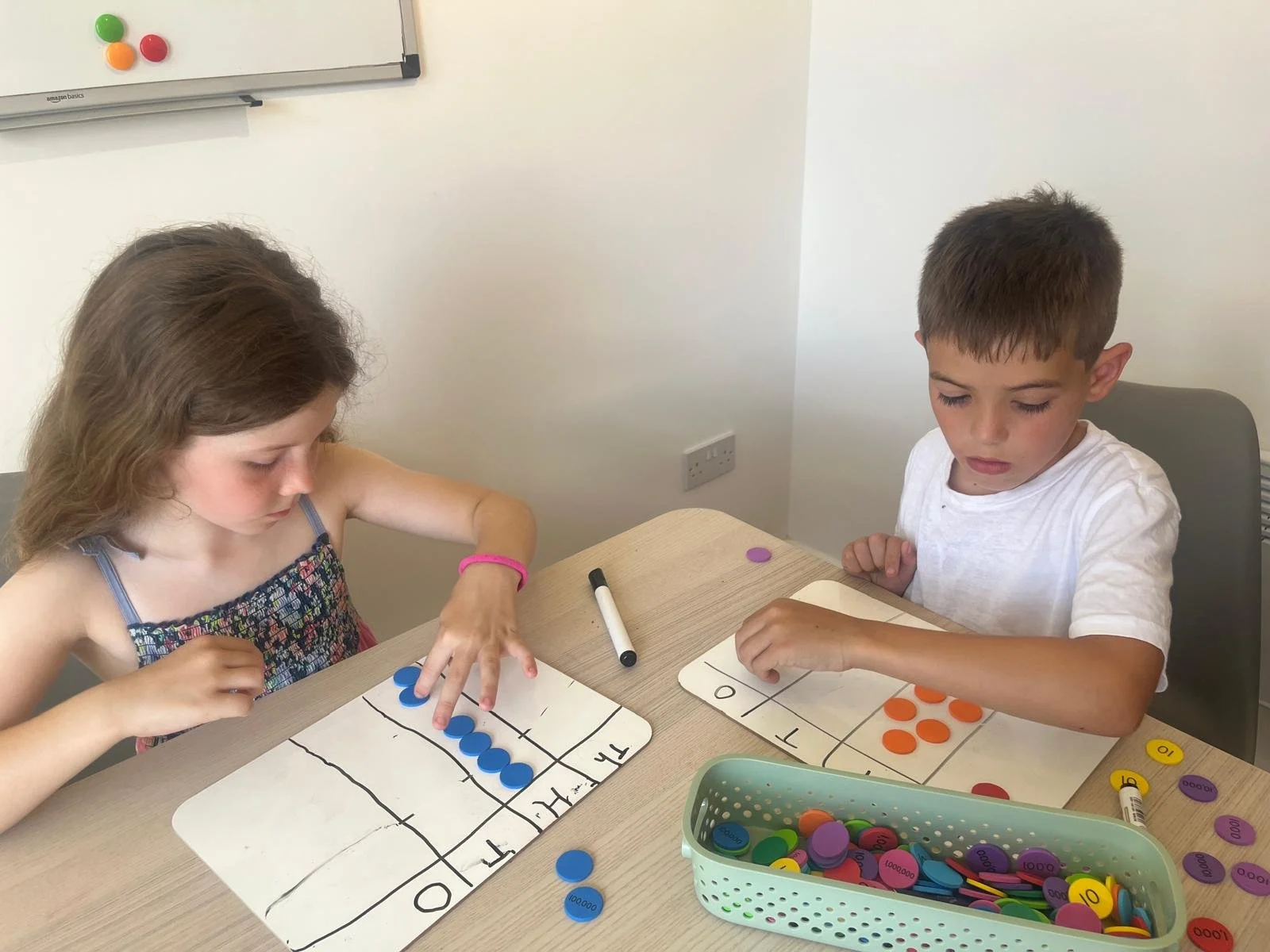
With four children, every single one is talking about maths, regularly, in every session. I can ask "can you explain that using the word equivalent?" and actually wait for a real answer, then help another child build on it. That's where vocabulary genuinely embeds — not through repetition on a page, but through use.
With four children, every single one is talking about maths, regularly, in every session.
〰️
With four children, every single one is talking about maths, regularly, in every session. 〰️
What This Means for You at Home
You don't need to become a maths teacher overnight, and you certainly don't need to relearn KS2 curriculum vocabulary yourself before you can support your child. But a few small habits go a long way.
Ask them to explain it
When your child brings home a new topic, ask them what the key words mean in their own words. If they can explain it, they've understood it.
Use the right word back
Resist the urge to swap in a “simpler” word if they use the correct one. Let it stand — and use it back to them.
Look it up together
If you don't know a term yourself, look it up together. Modelling curiosity about the language of maths is just as valuable as knowing it already.
Keep a maths dictionary nearby
An illustrated maths dictionary written for primary-aged children can be a quick, reliable way to check unfamiliar vocabulary together — with clear definitions and pictures, without needing to reach for a “simpler” substitute.
Maths, at its heart, is a language. The sooner children are fluent in its actual vocabulary, the more confidently they'll be able to think, explain, and problem-solve — not just this term, but for years to come.
Would a little extra maths support help?
Carrie's small-group tutoring sessions in Ampthill give children the time and space to talk through their maths, ask questions and build confidence in the language and concepts they're learning at school.
